
- Individuals & Families
- Businesses
- Agents & Brokers
- Embedded Insurance

Because pets are family, Chubb now offers pet insurance with top-rated coverage from Healthy Paws.

Chubb offers the insurance protection you need for travel’s many “what ifs”.

Chubb protects small businesses at every stage – from newly formed start-ups to long-time anchors of the community.

Stay ahead of cyber threats with our free Cyber Claims Landscape Report.

Learn more about our dedicated learning paths, Online Learning Center, and more.



Many digital-savvy consumers look for it as a core or add-on option.
Many digital-savvy consumers look for it as a core or add-on option.
Many digital-savvy consumers look for it as a core or add-on option.

Chubb’s in-house technology makes it easy to integrate what we do into your customer experience.
That lower premium feels like a smart deal — until you're stranded, undervalued, or handed a repair bill your policy won't cover.
Owning a boat is one of life's pleasures. The open water, the fresh air, the freedom of setting your own course — these are the things that make every hour of maintenance, every dockage fee, and every fuel fill-up worth it. So when it’s time to purchase insurance for your boat or yacht, why pay more?
Because, as thousands of boat owners discover every year, by paying less you may be missing the coverage that matters most, when you need it most.
Basic boat and yacht insurance policies often offered by insurance companies may limit what those companies have to pay in the event of a claim. The result can be a web of exclusions and fine-print clauses that might only become visible at the worst possible moment — when something has gone wrong, especially while on the water.
Cheaper policies typically use Actual Cash Value to calculate claim payouts, while comprehensive policies use Agreed Value
One of the most significant and least advertised differences between many lower-cost boat and yacht policies and a comprehensive policy like Chubb’s Masterpiece Boat and Yacht products is how the value of your boat is estimated in the event of a total loss. Standard policies often use a provision called “Actual Cash Value” (ACV), which means the insurer will calculate what your vessel is worth on the day of the claim, after accounting for depreciation factors like age, wear and tear, or obsolescence.
The reality is materials wear out, technology advances, and the market fluctuates. The boat you insured for $85,000 three years ago might be valued at $60,000 by an adjuster today, regardless of how well you've maintained it or what you originally paid. If something happens and there’s a total loss to your watercraft, you may find yourself $25,000 short of replacing it with something comparable. It’s in this moment that boaters find out the true value of their insurance policy.
Clients can enjoy stronger coverage with policies that establish an “Agreed Value” at the time the policy is written — this is where both you and the insurer commit to a specific dollar amount for the vessel up front. With a policy with an Agreed Value provision, in the event of a total loss, there's no negotiation, no depreciation formula, and no adjuster haggling. You know exactly what you'll receive.
Basic policies may not cover OEM parts for repairs
If something happens to your boat’s engine, electronics, or hull, what replacement parts will your insurer pay for? Basic policies frequently allow and sometimes even require the use of aftermarket or reconditioned components rather than original equipment manufacturer (OEM) parts. Why? It’s not because they’re better or safer. It’s because they’re cheaper.
OEM parts are built to the exact specifications of your vessel's manufacturer. They fit correctly, perform to design standards, and typically come with manufacturer warranties. Aftermarket alternatives can vary wildly in quality, and because mechanical reliability is a safety issue on boats and yachts, that variation matters.
Policies that commit to the use of OEM parts whenever they're available aren't just offering a fancy upgrade. They're offering a guarantee that your boat will be restored to its original condition or better, not an approximation of it.

Lower-cost policies may not cover customization or upgrades
Many boat owners invest in customizing their vessels, including upgraded navigation systems, custom teak work, specialized fishing equipment, upgraded seating, and enhanced audio systems.
If you make these types of customizations to your boat and a lower-cost policy has no provision for that, you could walk away from a major claim with a check that doesn't come close to restoring what you actually had.
The better approach is a policy that commits to restoring your vessel to its customized condition, up to policy limits, rather than simply replacing it with a base-model equivalent.
Lower-cost policies may not offer temporary substitute watercraft
If your boat or yacht sustains major damage, having to miss out on the boating season can only add to the frustration. Comprehensive policies like Chubb’s will often pay for temporary substitute watercraft while your watercraft is being repaired, a coverage not typically offered by standard industry policies and which can leave you sidelined when you want to be out on the water most.
Lower-cost policies may not cover storm preparation expenses
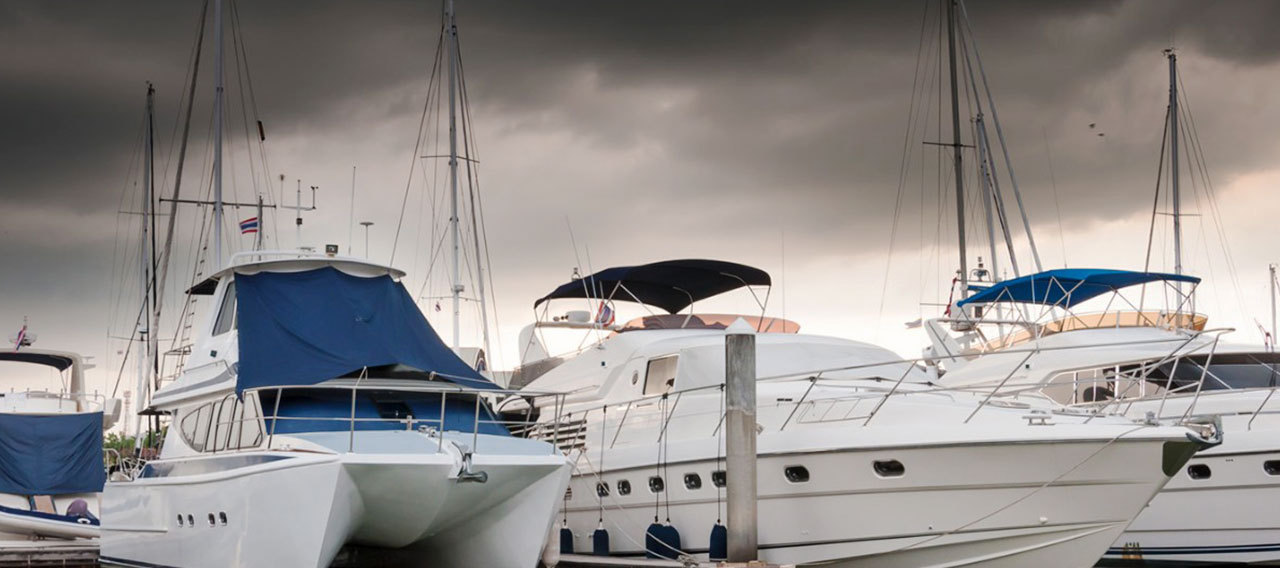
Severe weather is a leading cause of major watercraft claims. When a tropical storm or hurricane is approaching your marina, your boat is at serious risk. Moving your vessel to safer ground or securing it properly can save you weeks or months of downtime as you wait for repairs. Or worse, the vessel is damaged beyond repair and you’re forced to compete with other boaters in the area searching for replacement watercraft, often resulting in inflated prices as inventory becomes scarce. That’s why prevention is the smartest way to stay on the water.
Haulout fees, emergency dockage, fuel, and transport can run into hundreds or even thousands of dollars depending on the vessel and the circumstances. Standard policies may treat this expense as the owner's problem: the damage that results from a storm may be covered, but the cost of preventing that damage proactively is not, which may ultimately result in you missing a significant portion of the season.
Comprehensive policies will typically cover storm preparation expenses so you can protect the asset both parties have an interest in saving.
Lower-cost policies may exclude or provide limited coverage for towing services
Mechanical failure at sea happens; engines break down, props foul, and fuel lines fail. When it happens, towing services are expensive — often several hundred dollars per hour for a commercial marine tow, which can be even more costly during challenging conditions.
Some insurance policies include towing coverage, while others do not or they bury it in an optional add-on that's easy to overlook when looking at a cheap quote. Even policies that include emergency towing may cap it at amounts that don't reflect the real cost of a tow for more than a few miles offshore, leaving you exposed to significant out-of-pocket costs.
Before accepting any policy, read the towing provisions carefully. A policy that includes emergency towing and assistance automatically — with the option to select higher limits — is significantly different from one that offers it as an afterthought or not at all.
Not all insurers handle claims quickly and smoothly
Coverage terms are important, and the claims process is where insurance becomes real. Some insurers manage claims through lengthy processes, third-party adjusters unfamiliar with marine assets, and settlements that may require negotiation at every step.
Companies like Chubb have built their reputation on claims handling — rapid response, adjusters who understand boats, and settlements that reflect what policyholders were actually promised. That reputation has developed over decades and is worth its weight in gold.
What the premium comparison leaves out
When you compare insurance premiums on a spreadsheet, you're often comparing numbers that don't always carry equal weight. A lower premium might afford you less certainty about what you'll receive in the event of a claim, less assurance about the quality of repairs, and a claims process that’s exclusions and haggling.
The question to ask isn't "what does this policy cost?" but rather "what am I getting with this policy?” The boating life is about adventure, escape, and timeless memories. Your insurance should support that by treating you fairly and getting you back on the water quickly — not undermining you at the moment you need it most.
For the life you’ve built, the protection you deserve
Get a quote from Chubb today and experience the difference, so you can enjoy the water with confidence and peace of mind, knowing your passion for being on the water is truly protected.
Related products
Our boat insurance policies are designed for all types of pleasure boats 35 feet and less, as well as personal watercrafts, like waverunners and jet skis. We provide competitive rates, along with valuable features to protect both boat owners and their vessels.
Our Masterpiece® Yacht insurance policy offers superior coverage for pleasure yachts 36 feet or greater in length. And for captained vessels 70 feet or greater in length and valued at $3 million or more, our Masterpiece Yacht Preference policy has the specialty coverages you and your crew need.
Insights and expertise

This document is advisory in nature and is offered as a resource to be used together with your professional insurance advisors in maintaining a loss prevention program. It is an overview only, and is not intended as a substitute for consultation with your insurance broker, or for legal, engineering or other professional advice.
Chubb is the marketing name used to refer to subsidiaries of Chubb Limited providing insurance and related services. For a list of these subsidiaries, please visit our website at www.chubb.com. Insurance provided by ACE American Insurance Company and its U.S. based Chubb underwriting company affiliates. All products may not be available in all states. This communication contains product summaries only. Coverage is subject to the language of the policies as actually issued. Surplus lines insurance sold only through licensed surplus lines producers. Chubb, 202 Hall's Mill Road, Whitehouse Station, NJ 08889-1600.