
- Individuals & Families
- Businesses
- Brokers

With winter on its way out, you may be ready for some spring cleaning.

Make sure you protect your classic cars from damage or additional wear and tear.

Keep your important papers and small valuables away from burglars, fire or natural disaster.

For over a hundred years, we’ve offered unparalleled stability and protection for small boats, yachts, luxury mega-yachts, and more.

Here are some things you can do to assist firefighters and minimize the damage to your home.

At their worst, disputes between professional service firms and their clients can lead to costly lawsuits.
Environment & Climate Change

Corporate citizenship
- Recognizing and responding to the reality of climate change across our businesses
- Managing environmental risk for our customers with innovative products and risk engineering solutions
- Supporting resilience projects throughout the world
- Protecting biodiversity and conserving land
- Reducing the environmental footprint of our own operations

Chubb and climate change
Strategy
Chubb is an underwriting company, and the company strives to emphasize quality of underwriting. The company’s underwriting strategy is to manage risk by employing consistent, disciplined pricing and risk selection. Chubb applies the same risk management rigor to its broadly diversified investment portfolio as it does to the company’s underwriting practice. In addition, Chubb accounts for the potential impact of catastrophe and climate risks on the company’s own facilities and operations. Direct risk to Chubb’s business operations exists to the extent that increasingly frequent or severe weather events associated with climate change occur where Chubb has offices.
Governance
At Chubb, assessing and managing risk starts at the top, with senior management. Risk management at Chubb is rigorous, with processes and governance to provide checks and balances. Chubb’s global enterprise risk management (ERM) framework — which encompasses climate risk — is embraced by colleagues at all levels of the company, from the Chief Executive Officer (CEO) and Board of Directors, down to each business unit and function. It is broadly multi–disciplinary and one of its objectives is effective governance.
Risk management
The potential impacts of climate change on the insurance industry are myriad and multivariate. These risks and opportunities fall broadly into three categories: physical risks and opportunities; transition risks and opportunities; and liability risks and opportunities
Corporate Sustainability Policies
At Chubb, we seek to implement corporate sustainability policies that deliver enduring operational efficiencies and positive environmental outcomes across our businesses. As part of these efforts, we track and report our scope 1 and scope 2 greenhouse gas emissions on an annual basis in our Sustainability Report.
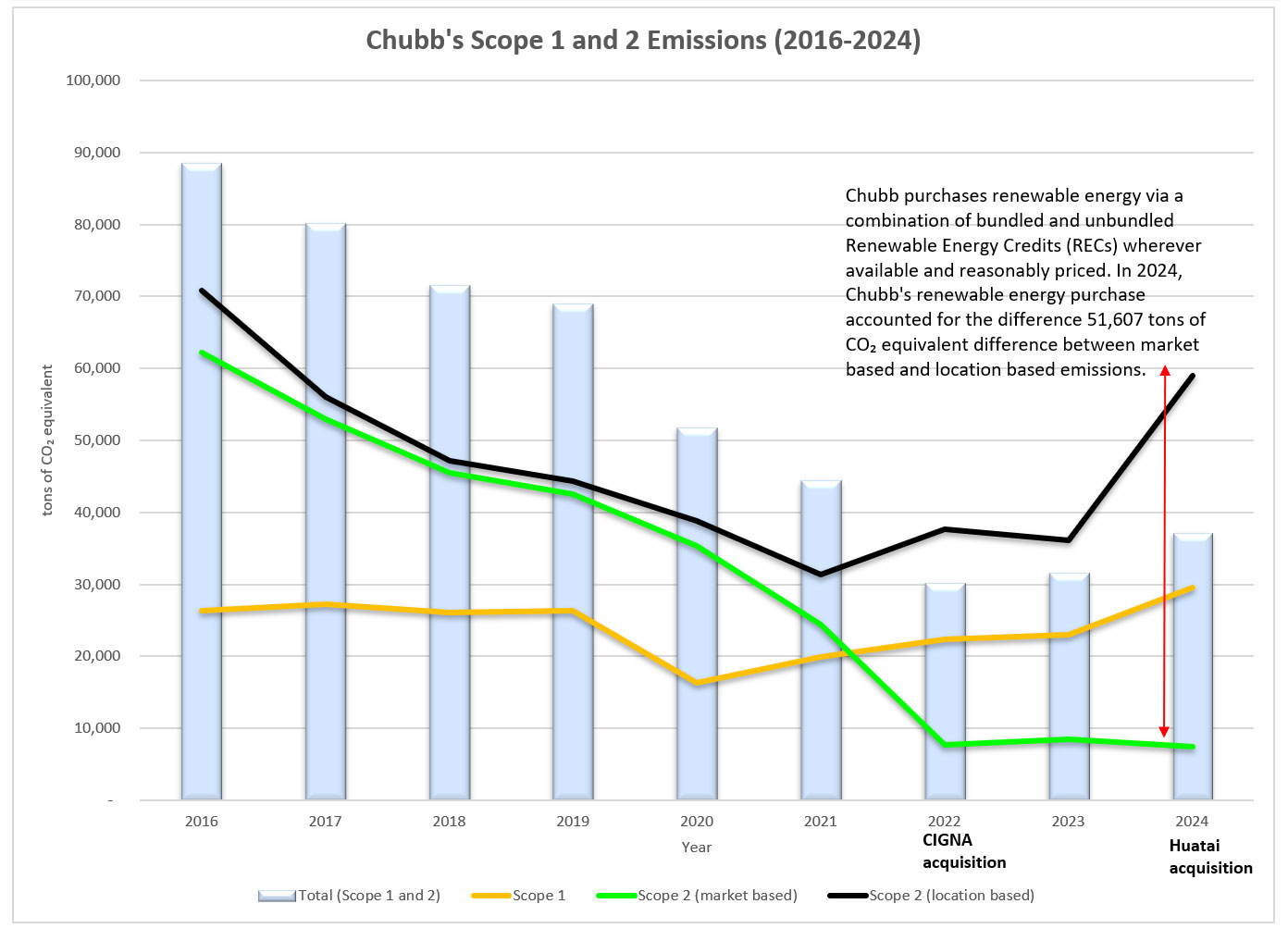
Chubb purchases renewable energy via a combination of bundled and unbundled Renewable Energy Credits (RECs) wherever available and reasonably priced. In 2024, Chubb's renewable energy purchase accounted for the difference 51,607 tons of CO₂ equivalent difference between market based and location-based emissions.
Chubb's Scope and Scope 2 market based emissions declined from 2016 through 2024. This was achieved primarily through Chubb's Green Power Purchase Policy, which states that Chubb will purchase renewable energy wherever available and reasonably priced. Chubb's renewable energy purchases include PPAs, bundled RECs, and unbundled RECs. They do not include hydro power or nuclear power.
Canada Scope 1 Emissions = 242 (mtCO2 e)
Canada Scope 2 Emissions (location-based) =74 (mtCO2 e)