
Future of Autonomous Vessels
Consultant McKinsey has issued a future-looking report that, among other things, predicts ships will be autonomous and capable of carrying up to 50,000 teu (twenty-foot equivalent units). In terms of scale, the current record breaking 22,000 teu ships under construction for MSC and CMA CGM could be dwarfed in years to come.
Short-haul intra-regional traffic will increase, they assert, as manufacturing footprints disperse more widely because of converging global incomes and the increasing use of automation and robotics. Container flows in East and Southeast Asia will continue to be huge, and the second most significant trade lane may link that region to Africa.
Also, fifty years from now, McKinsey suggests freight forwarders might not exist due to digital interactions that will reduce the need for them to manage logistics services for multiple participants in the value chain. Across the industry, all winners will have fully digitized their customer interactions and operating systems and will be closely connected via data ecosystems.
A 50-year forecast is a fairly safe one to make; most of the people who read it won’t be around or be able to remember it if they are. Today our horizon is measured in months not even years yet alone decades. This one is fanciful. Give us a near-term vision, one more relevant to our times. I don’t see 50,000-teu ships or the wholesale demise of freight forwarders. The world’s ocean trade routes effectively limit the size of vessels and our port infrastructures are scope restrictors. There will always be a need for transportation intermediaries; they may be in a different form, but they are not going away.
New IMO Model for solid bulk cargo
A new IMO Model Course on Safe Handling and Transport of Solid Bulk Cargoes has been validated by the Sub-Committee on Carriage of Cargoes and Containers. The course focuses on the mandatory measures for handling and transport of solid bulk cargoes outlined in the International Maritime Solid Bulk Cargoes (IMSBC) Code. It will cover all solid bulk cargoes, including those which may liquefy when moisture limits are reached and cause instability of the ship. These cargoes require that particular attention is paid to testing and recording moisture levels prior to loading.
Under its ongoing work, the Sub-Committee also considered proposed amendments to the inspection programs for cargo transport units carrying dangerous goods and finalized the work to develop draft amendments to the Code of Safe Practice for Cargo Stowage and Securing (CSS Code) related to weather-dependent lashing, aimed at ensuring the highest level of cargo securement, taking into account expected climatic conditions and other factors.
While the aforementioned course is intended for seafarers on board ships carrying solid bulk cargoes, and personnel involved in its transport chain such as shippers, port authorities and marine terminals, it is useful for anyone involved in the assessment of acceptability of consignments of solid bulk cargoes per the IMSBC Code. We suspect that would include insurance underwriters and their technical support staff.
Changes in C-TPAT
Remember C-TPAT, the program that has been an integral part of U.S. Customs and Border Protection’s (CBP) cargo enforcement strategy to combat terrorism, illegal contraband, and other supply chain threats since 9/11?
It brings together private sector businesses and the federal government in the collaborative effort to improve border security with over 11,500 participants today from 12 categories of stakeholders: U.S. Exporters, U.S. Importers, Mexican and Canadian Manufacturers, Mexican Long Haul Highway Carriers, Air Carriers, Rail Carriers, Sea Carriers, U.S. Highway Carriers, Third Party Logistics Providers, Consolidators, U.S. Marine Port Authority & Terminal Operators, and U.S. Customs Brokers.
CTPAT has been around a long time but it has undergone some changes. The foundational component of the program is the Minimum-Security Criteria or MSC.
The updated MSC are segmented into three main categories; Corporate Security, Transportation Security, and People and Physical Security. Within each of these are twelve subcategories with new entrants such as Cybersecurity, Agricultural Security, and Security Vision and Responsibility.
The table below illustrates the categories, subcategories, and suggested phased implementation approach:
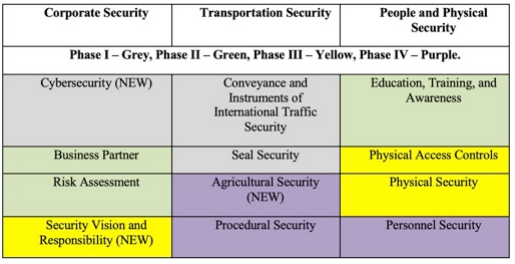
The revision was designed to update the criteria to ensure they truly reflect the current supply chain environment. It also represents over 30 months of collaboration within a series of Working Groups comprised of subject matter experts in certain areas of interest. All C-TPAT members are expected to comply with the new requirements by 2020.
The Plimsoll Line
A commercial ship is properly loaded when the ship’s waterline equals the ship’s Plimsoll line. The Plimsoll line is a reference mark located on a ship’s hull that indicates the maximum depth to which the vessel may be safely immersed when loaded with cargo. This depth varies with a ship’s dimensions, type of cargo, time of year, and the water densities encountered in port and at sea. Once these factors have been accounted for, a ship’s captain can determine the appropriate Plimsoll line needed for the voyage:
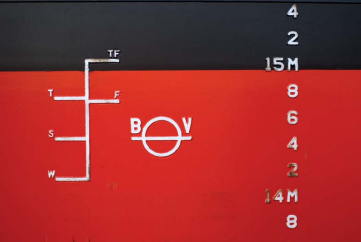
TF = Tropical Fresh Water
T = Tropical
F = Fresh Water
S = Summer
W = Winter
BV = Letters indicating the vessel’s Classification Society (Bureau Veritas)
For history buffs and those wanting to impress at a holiday cocktail party, Samuel Plimsoll (1824–1898) was a member of the British Parliament who was concerned with the loss of ships and crews due to vessel overloading. In 1876, he persuaded Parliament to pass the Unseaworthy Ships Bill, which mandated marking a ship's sides with a line that would disappear below the waterline if the ship was overloaded. It is still used worldwide.
OOCL more into technology
OOCL introduced new advances to MyOOCLReefer (MOR) Services. The container line’s latest iteration is leveraging the latest technologies in areas such as Artificial Intelligence (AI), Internet of Things (IoT), mobile and telematic devices to provide transparency, visibility and convenience to shippers when managing their refrigerated cargo shipments.
At sea, the real-time monitoring of the vessel’s schedule and substantially more accurate Estimated Time of Arrival (ETA) can give shippers more control over the supply chain where timing of their products to shelf is critical while on land, the constant oversight of the reefer container temperature settings can allow for recovery action.
Much of the betterments are the result of a close affiliation with software solutions provider
CargoSmart, a sister company. CargoSmart’s Global Vessel Voyage Monitoring Center monitors and analyzes data of over 16,000 vessels, 800 ports, 1,400 terminals and tracks multiple ocean carriers covering more than 3,000 services and 10 million sailing schedules. Its extensive database coupled with AI can process a mix of variables such as vessel sailing patterns, terminal productivity, and carrier schedule performance to provide predictive analytics.
OOCL is joining a host of their competitors in this space with larger vessel operators such as Maersk and MSC also offering “smart” container fleets. The key will always be the ability to react to an issue whether on land or on the water. Providing data to shippers is a benefit but data and visibility are just partial solutions; they need to be coupled with a viable end-end response plan either by the shipper, the carrier or a combination of both.
Pharmaceutical shipping news
Pharma.Aero, a global cross-industry association aligning members from airport communities, pharmaceutical shippers and other air cargo stakeholders, has announced that global animal health company Zoetis has become its latest member.
Zoetis joins the current group of pharma shippers - Pfizer, Johnson & Johnson and Merck Sharpe Dohme. Member companies also include Brussels, Singapore and Miami airports, AirBridgeCargo, Singapore Airlines, Turkish Airlines Cargo, Worldwide Flight Services (WFS), DHL and Expeditors
- The association’s objectives include:
- Developing air cargo as a reliable transport method for pharma
- Becoming leaders in developing cold chain solutions
- Sharing market knowledge, expertise and best practices
- Organizing local and regional forums, workshops and networking events
Shippers in the Life Sciences vertical are continually to look for modal options particularly examining the use of far more affordable but more time-consuming ocean transport versus the faster but more costly air option. You can learn more about them at http://pharma.aero
The information for much of the content was taken from a number of public sources that, to the best of the undersigned’s knowledge, is accurate. The views expressed in this document should be regarded as the personal opinion of the undersigned and not necessarily of the Chubb. If anyone wants additional information on any of the topics covered contact the authors. |